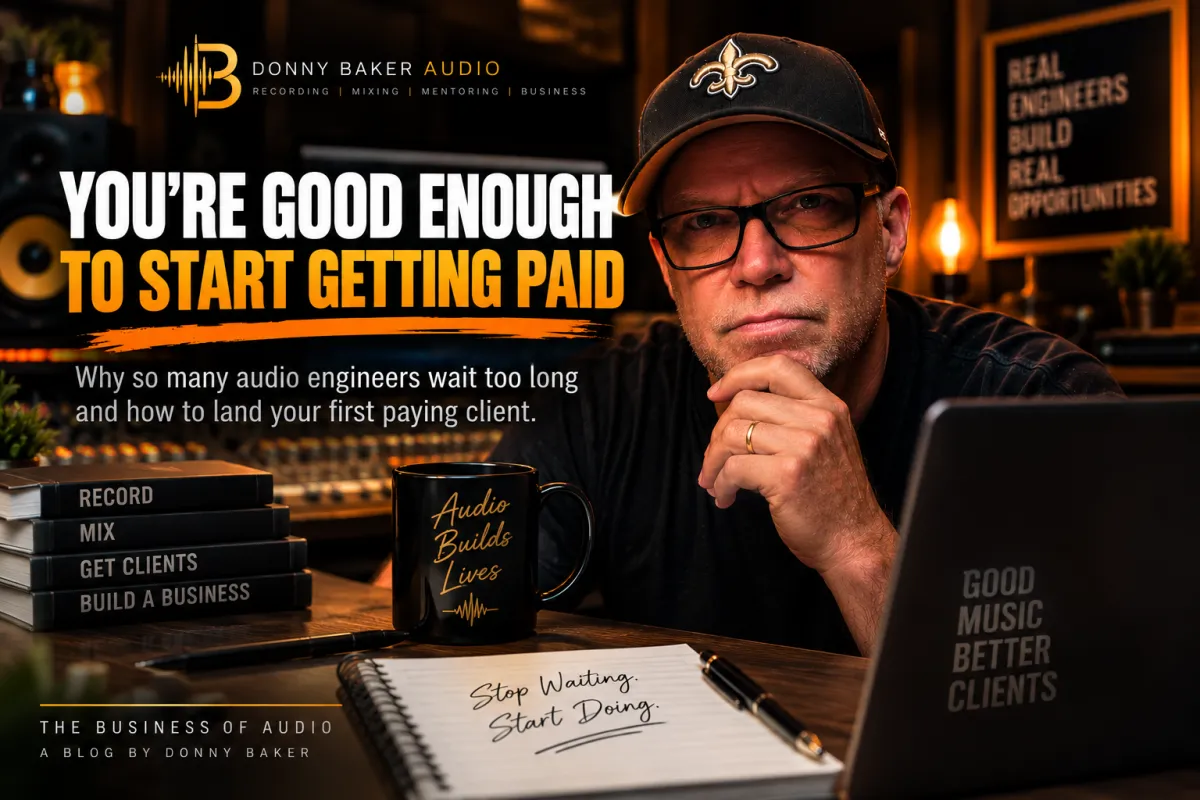
You’re Good Enough to Start Getting Paid
There’s a point where learning becomes hiding.
That might sound a little harsh, but I see it happen all the time with audio engineers.
You practice.
You watch tutorials.
You buy another plugin.
You work on another mix.
You upgrade your monitors.
You improve your room.
You take another course.
And you keep telling yourself:
“I’m just not ready yet.”
Six months goes by.
Then a year.
Sometimes several years.
You’re still learning. Still practicing. Still preparing.
But you’re not getting paid.
At some point, you have to stop preparing to have an audio career...
and start having one.
I’m Not Saying Everybody Is Ready
Let’s get this out of the way first.
I’m not saying you can buy Pro Tools today, watch a few YouTube videos, and start calling yourself a professional audio engineer tomorrow.
You have to be able to do the work.
If somebody is paying you to solve a problem, you need to be capable of solving that problem.
There is a minimum professional standard.
But there’s a big difference between:
“I don’t know how to do this yet.”
and:
“I know how to do this, but I’m afraid to ask somebody to pay me for it.”
That second one is where I see a lot of talented people get stuck.
They’re waiting to feel ready.
The problem is...
There Is No “Ready” Certificate
Nobody ever came to me and said:
“Congratulations, Donny. You are now officially a professional audio engineer.”
I started doing the work.
I learned from people who knew more than I did.
I made mistakes.
I solved problems.
I got better.
Then I did more work.
And I got better again.
More than 40 years later, I’m still learning.
I still encounter things I haven’t seen before.
I still try new techniques.
I still change the way I do things.
That's part of being a professional.
You don’t finish learning and then start working.
You learn by working.
There comes a point where another six months of practicing by yourself isn’t going to teach you what one real client will.
Because now there are expectations.
Deadlines.
Communication.
Revisions.
Problems you didn’t anticipate.
And somebody on the other end expecting you to deliver what you promised.
That experience is incredibly valuable.
Your First Client Doesn’t Need the World’s Best Engineer
This is something I wish more new audio engineers understood.
Your first client probably isn’t looking for the greatest engineer in the world.
They’re looking for somebody they trust who can solve a problem.
Maybe their podcast sounds terrible.
Maybe they need someone to edit their vocals.
Maybe their YouTube videos need better audio.
Maybe their band needs a demo.
Maybe they have a song that needs mixing.
Maybe they just need someone who knows how to properly record a vocal.
The question you should be asking yourself isn’t:
“Am I as good as the biggest mixer in Los Angeles?”
The question is:
“Can I solve this person’s problem?”
If the answer is yes, you have value.
And people pay for value.
That’s the same principle behind my How to Get Your First Paying Audio Client guide: your first client isn’t looking for the world’s best engineer. They’re looking for someone they trust to solve a problem.
Stop Selling Recording
Here’s another place new engineers get stuck.
They try to sell the thing they do instead of the problem they solve.
People don’t wake up in the morning thinking:
“You know what I need today? Some Pro Tools.”
They don’t care about your DAW.
They probably don’t care what microphone you own.
They don’t care about your plugin collection.
We care about that stuff because we’re audio people.
Your client cares about the result.
Instead of:
“I offer podcast editing.”
Think:
“I can make your podcast sound professional and save you hours of editing it yourself.”
Instead of:
“I have a recording studio.”
Think:
“I can help you make a professional recording of your song.”
Instead of selling recording...
Sell the solution.
That’s exactly how I frame it in the First Paying Audio Client guide: people aren’t shopping for Pro Tools; they’re trying to get better audio and solve a specific problem.
More Gear Isn’t Going to Make You Feel Ready
Audio engineers are really good at this one.
We tell ourselves:
“I could start taking clients, but I really need...”
A better microphone.
Another preamp.
Better monitors.
Another plugin bundle.
More acoustic treatment.
A new computer.
A bigger desk.
Maybe some new cables while we’re at it.
And there's nothing wrong with buying equipment you actually need.
But gear can also become a very expensive form of procrastination.
You can spend years building the world’s greatest studio...
that nobody is paying you to use.
At some point, another compressor plugin isn't going to get you a client.
Talking to somebody might.
The guide makes the same point pretty directly: more plugins, microphones, gear, and courses aren’t what get you that first client. Talking to people does.
Your First Client May Already Be in Your Phone
Before you start worrying about advertising...
Before you start trying to build thousands of followers...
Before you spend six months rebuilding your website...
Open your phone.
Who do you already know?
Musicians?
Podcasters?
Content creators?
Business owners?
Former coworkers?
People you’ve recorded before?
Friends who know musicians?
That person who seems to know everybody in town?
One of the biggest mistakes we make when trying to find clients is assuming they have to be strangers.
They don’t.
In fact, your first client may already trust you.
They just may not know what you do.
That's why the first-client guide starts with your existing network—friends, musicians, former coworkers, podcasters, content creators, business owners, and other people already around you.
You Don’t Need 100 Clients
I see people starting an audio business and immediately worrying about how they're going to get enough clients to make six figures.
Forget that for a minute.
You don’t need 100 clients right now.
You don’t even need 10.
You need one.
One person.
One problem you can solve.
One project.
One invoice.
One payment.
That first paying client changes something.
Because now you know:
Somebody will actually pay me to do this.
You also gain something you didn't have before.
Experience.
Confidence.
Possibly a testimonial.
Maybe a referral.
And momentum.
That's why I think the first client is so important. The goal isn't to build the entire business overnight.
Get one.
Then figure out how to do it again.
Your First Client Probably Won’t Come From an Algorithm
Could someone discover you on YouTube or Instagram and hire you?
Absolutely.
But I wouldn't sit around waiting for that to happen.
Your first client probably isn't going to come because an algorithm suddenly decides to make you famous.
It'll probably come because you had a conversation.
You told somebody what you do.
You asked what they were working on.
You offered to help.
Or somebody who already knows you introduced you to someone who needed what you do.
As I say in the guide:
Your first paying client is probably already in your phone. You just haven't told them what you do.
That's not nearly as exciting as some secret social media strategy.
But it works.
Here’s Your Challenge
Before tomorrow night, contact five people.
Not 500.
Not 50.
Five.
Find five people who might need audio help—or might know somebody who does.
Tell them what you do.
You don't need a complicated sales pitch.
Something as simple as:
“Hey, just wanted to let you know I’m taking on some new audio projects. If you or somebody you know needs help with recording, mixing, editing, or production, I’d love to talk.”
That's it.
Start a conversation.
The action checklist in the guide follows the same idea: tell five people what you do, reconnect with people in your network, ask for an introduction, and stop waiting to feel ready.
Stop Waiting
If you truly aren't ready yet, keep learning.
Practice.
Make mistakes.
Record more.
Mix more.
Learn from people who have done it before you.
Get better.
But if you can solve somebody's problem and the only thing stopping you is that you don't feel ready...
Stop waiting.
You don't need the perfect studio.
You don't need every plugin.
You don't need thousands of followers.
And you certainly don't need to know everything.
You need:
One person.
One problem you can solve.
One conversation.
Then you do it again.
You don't have to feel like a professional before you start.
Doing the work is part of how you become one.
Ready to Find Your First Paying Audio Client?
I put together a free guide called:
HOW TO GET YOUR FIRST PAYING AUDIO CLIENT
Inside, I'll show you:
Where I'd look for that first client
Five types of people I'd contact today
Simple examples of what to say
How to think about selling solutions instead of recording
A straightforward action checklist to get you moving
🟧 GET THE FREE GUIDE
Available free inside The Business of Audio Free Resources.
No need for another six months of waiting.
Start the conversation.
Get Good. Get Clients. Get Paid.
