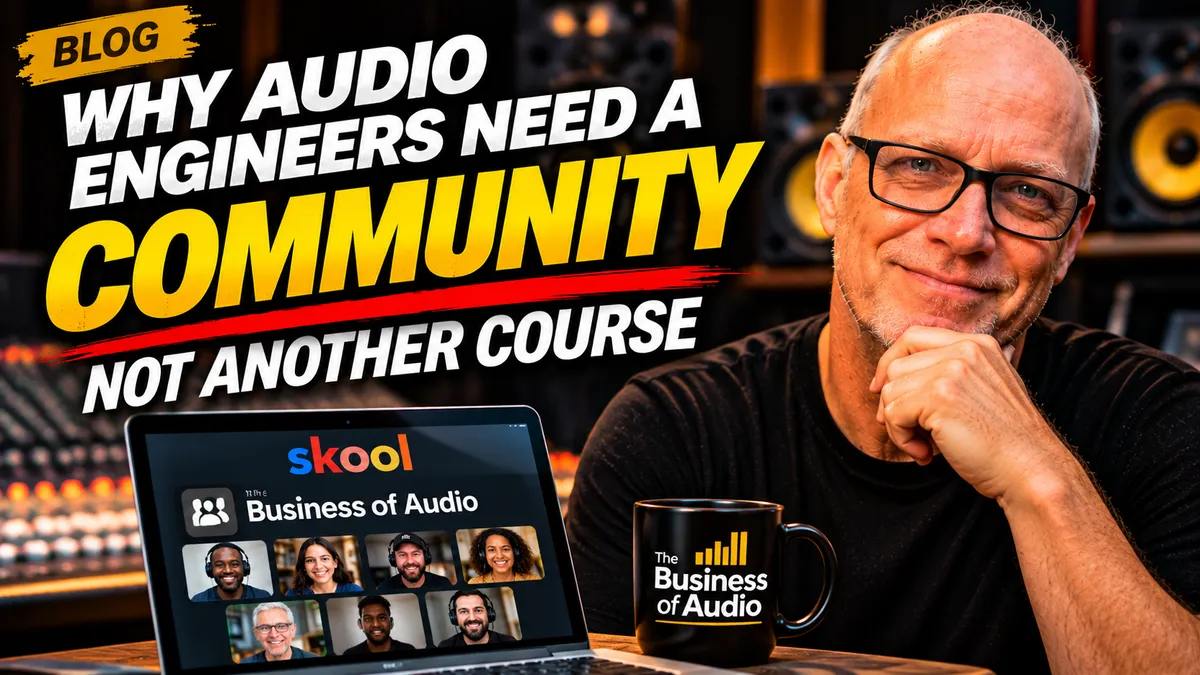
Why Audio Engineers Need a Community, Not Another Course
After more than 40 years in the audio business, I've learned that who you know, who you learn from, and who you help can be just as important as what you know.
You know something I've learned after more than 40 years in the audio business?
Nobody makes it in this business completely by themselves.
We learn from other engineers. We ask questions. We make connections. We share ideas. And sometimes, those relationships turn into opportunities that change the direction of our careers.
That's how this business has worked for decades.
But somewhere along the way, learning audio became a business of selling courses, certifications, and promises.
Don't misunderstand me. There's nothing wrong with taking courses or getting an education. I've spent a good portion of my career teaching aspiring audio engineers.
But I think we've lost sight of something important.
Community.
And that's why I've decided to make some pretty significant changes to The Business of Audio.
I've Been Rethinking My Community
I've been building The Business of Audio community for a while now.
During that time, I've experimented with different membership levels, pricing structures, courses, workshops, and coaching programs.
I've tried to figure out what aspiring audio engineers, producers, and studio owners actually need to help them succeed.
And somewhere along the way, I started wondering whether I was making things more complicated than they needed to be.
I don't want to be another internet guru.
I don't want to build a place where everybody sits around waiting for me to tell them what to do.
I want to build a place where audio engineers help other audio engineers.
A place where people can learn, share experiences, ask questions, make connections, and grow together.
So I've made a decision.
Everything in The Business of Audio classroom is now FREE.
All the existing training and resources.
Our weekly hangout.
Our weekly open coaching session.
All free.
And I want to explain why I think this is a better direction for the community.
1. Stop Trying to Figure Everything Out Alone
Think about how people learned the audio business years ago.
You got involved.
Maybe you started as a runner in a recording studio.
Maybe you helped a local band set up their equipment.
Maybe you worked alongside an experienced engineer and watched how they handled a session.
You asked questions.
You made mistakes.
And you learned from the people around you.
That's certainly how a lot of us got started.
When I began working in live sound more than 40 years ago, there wasn't a YouTube video available to answer every question.
You learned by doing the work and being around people who knew more than you did.
And those relationships were valuable.
They still are.
Today, we have access to more information than ever before.
You can find tutorials on just about anything related to recording, mixing, mastering, or music production.
And that's great!
But watching a video isn't the same as working alongside somebody.
A prerecorded tutorial can't answer your specific follow-up question.
And a mixing course isn't necessarily going to introduce you to the person who might become your next client.
Information is valuable. But relationships are valuable, too.
That's one of the biggest reasons I want The Business of Audio to become a real community.
2. Participation Beats Collecting Courses
Here's something I see all the time.
Aspiring engineers spend hundreds of hours watching tutorials.
They buy courses.
They download guides.
They collect plugins.
And they keep telling themselves they're getting ready to become audio engineers.
But they're not recording anybody.
They're not mixing anything.
They're not putting their knowledge to work.
Now, don't get me wrong.
I'm a big believer in education.
After more than 40 years in this business, I'm still learning new things.
But at some point, you have to stop collecting information and start using it.
And that's where a community can make a real difference.
Imagine you're working on a mix and can't figure out why the vocals aren't sitting properly.
You could spend another three hours watching YouTube videos.
Or you could ask a question in a community filled with people who have probably dealt with that same problem.
Maybe somebody suggests a different approach to EQ.
Maybe somebody else recommends looking at your compression.
Or maybe the real problem has nothing to do with plugins at all.
Sometimes a fresh set of ears or a different perspective is exactly what you need.
And here's something else.
You don't have to be an expert to contribute.
Maybe you learned something about Pro Tools yesterday.
Somebody else might be struggling with that exact thing today.
Share what you learned.
That's how communities become valuable.
Not because one person has all the answers.
But because everybody brings something to the table.
3. Relationships Create Opportunities
Here's where things get interesting.
One of the biggest challenges aspiring audio engineers face isn't necessarily learning how to record or mix.
It's figuring out how to make money doing it.
How do you find clients?
How do you get somebody to trust you with their music?
How do you turn a skill into an actual business?
I've talked about this many times.
Your first paying client might already be somebody you know.
Maybe you have a friend who plays in a band.
Maybe somebody at church needs help recording music.
Maybe a local musician needs a mix.
Or maybe another engineer has more work than they can handle and needs somebody to help.
That's how opportunities happen.
People know people.
They make recommendations.
They refer clients.
They work together.
And that's another reason community matters.
Imagine being connected with audio engineers, producers, and studio owners from different places and different backgrounds.
Some are beginners.
Some have years of experience.
Some specialize in recording.
Others focus on mixing, mastering, production, or live sound.
Those connections can become valuable over time.
Now, joining a community doesn't automatically mean clients are going to start showing up.
You still have to develop your skills.
You still have to do good work.
And you still have to earn people's trust.
But building relationships is part of building a business.
Sometimes the person who helps you move forward isn't somebody teaching a course. It's somebody you met along the way.
So, What's Changing at The Business of Audio?
Here's what I've decided to do.
I'm opening up the community so anybody interested in audio engineering, music production, or running an audio business can participate without paying a membership fee.
And I want to keep things simple.
The Classroom — Free
All our existing classroom content is now available to members at no charge.
That includes training and resources covering recording, mixing, audio fundamentals, and the business side of audio.
You can work through the material at your own pace.
Learn what you need.
Practice what you learn.
And ask questions when you get stuck.
Weekly Hangout — Free
Once a week, we're getting together for a casual hangout.
No complicated agenda.
No formal presentation.
Just audio people talking about audio.
Maybe you're working on a recording project.
Maybe you're setting up a home studio.
Maybe you're trying to figure out how to find your first client.
Or maybe you just want to meet some other people who share your interest in audio.
Come hang out.
That's what it's for.
Weekly Open Coaching — Free
We're also holding one open coaching session every week.
Bring your questions.
Maybe you're struggling with a mix.
Maybe you need advice about recording equipment.
Maybe you're trying to figure out what to charge a client.
Or maybe you're thinking about starting your own studio.
We'll talk through the problems and see if we can find some practical solutions.
And I hope other members will contribute their own experiences and ideas.
Because again, this shouldn't be about me having all the answers.
The Community — Free
And then there's the most important part.
The members themselves.
I want people to introduce themselves.
Ask questions.
Share their projects.
Offer advice.
Make connections.
And help each other improve.
Because a community isn't really a community if nobody participates.
What About Private Coaching?
Now, some people are going to want more personalized help.
Maybe they're serious about starting a studio.
Maybe they've been struggling to find clients.
Maybe they want somebody to work directly with them on a specific business goal.
I'm developing a higher-level private coaching opportunity for those people.
That will be a separate, more personalized way to work with me.
But here's what's important.
You don't have to pay for private coaching to be part of The Business of Audio.
You don't have to upgrade to access the classroom.
You don't have to pay to attend our weekly hangout or open coaching sessions.
I want people to join, participate, and experience the value of the community first.
And if somebody eventually wants more individual help, we can have that conversation.
Simple as that.
Here's What I'd Like You to Do
If you're interested in recording, mixing, music production, or building a business around audio, I'd love to have you join us.
But I have one request.
Don't just join and disappear!
When you get inside, do three things.
First, introduce yourself.
Tell us who you are, where you're from, and what you're working on.
Are you just getting started?
Have you been recording for a few years?
Do you own a studio?
We'd love to know.
Second, join one of our weekly sessions.
Come hang out or bring a question to open coaching.
You don't have to be an expert.
You don't even have to have a question.
Just show up and get to know some people.
Third, help somebody else.
If you see a question you can answer, jump in.
If somebody shares a project, offer some encouragement.
If you've learned something useful, share it.
The more everybody participates, the better the community becomes.
Let's Build Something Together
I've spent more than 40 years making my living in the audio business.
I've worked with some incredible people.
I've learned a lot.
I've made plenty of mistakes.
And I'm still learning.
But one thing hasn't changed.
The people you surround yourself with matter.
The relationships you build matter.
And helping somebody else succeed is never a waste of time.
That's what I want The Business of Audio to become.
Not another place where everybody follows an internet guru.
Not another collection of courses that people buy and never finish.
A real community.
Where audio people help audio people.
Where we can all work toward the same basic goals:
GET GOOD. GET CLIENTS. GET PAID.
And hopefully have some fun along the way.
Come Join Us — It's Free!
If this sounds like something you'd like to be part of, come join The Business of Audio.
All our classroom training, weekly hangouts, and open group coaching sessions are free.
Join The Business of Audio:
https://www.skool.com/sound-foundations-8658/about
And when you get there, introduce yourself!
I'd love to know what you're working on and what you're hoping to accomplish.
I'm Donny Baker.
Learn to make your living making music happen.


