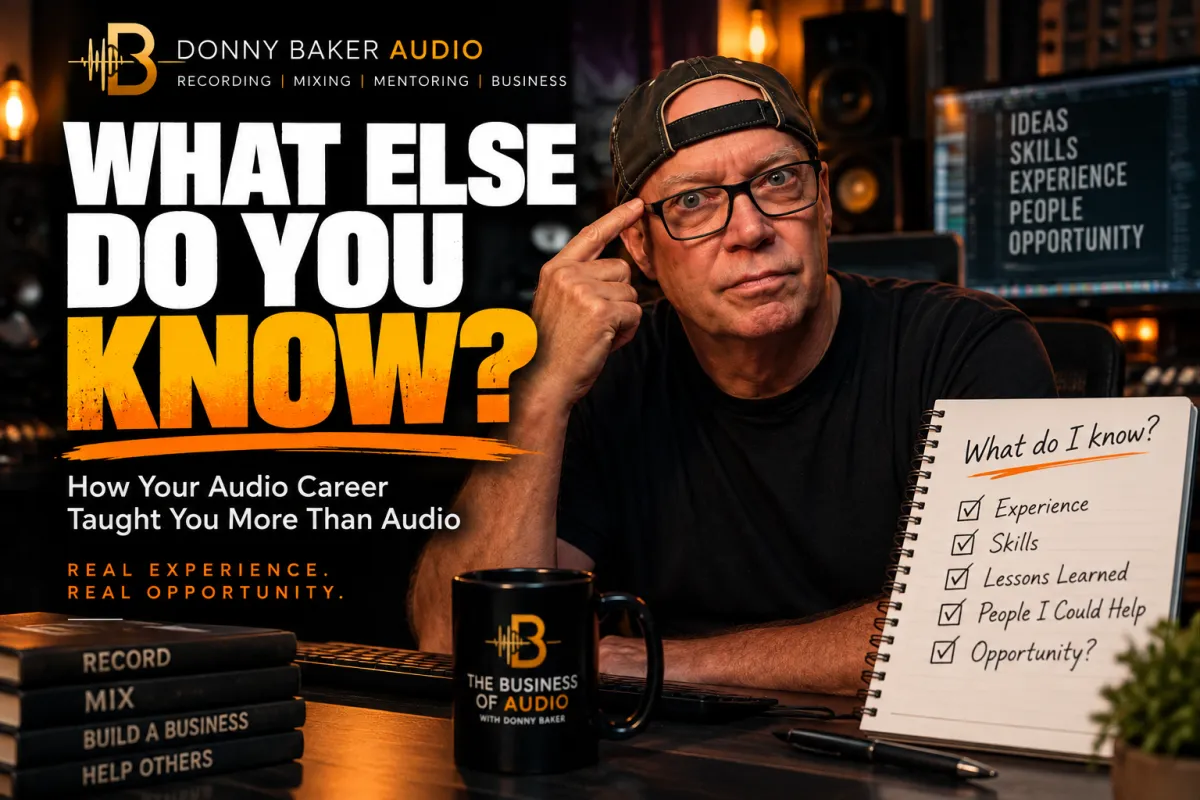
Your Audio Career Taught You More Than Audio
After more than 40 years working in professional audio, I’ve learned a lot about recording.
I’ve learned about microphones, consoles, signal flow, mixing, production, acoustics, troubleshooting and all the other things that come with spending a lifetime making music.
But lately I’ve been thinking about something.
Audio taught me a whole lot more than audio.
And I have a feeling the same thing may be true for you.
We Forget How Much We Know
When you’ve been doing something for a long time, something strange happens.
It starts to feel normal.
Someone asks you a question and the answer seems obvious.
You think:
“Everybody knows that.”
Except they don’t.
You know that.
You know it because you’ve spent years learning it.
You’ve made mistakes.
You’ve tried things that didn’t work.
You’ve solved problems.
You’ve dealt with situations you never expected.
And eventually, something that once seemed incredibly difficult became easy.
That’s experience.
The problem is that we tend to undervalue our own experience precisely because it has become easy for us.
Audio Taught Me How to Run a Business
Think about what actually happens over the course of an audio career.
Yes, I learned how to record.
I learned how to mix.
I learned how to produce records and work with artists.
But I also learned how to talk to clients.
I learned how to price my work.
I learned how to sell without feeling like I was selling.
I learned how to manage projects and deadlines.
I learned how to deal with difficult people.
I learned how to build systems.
I learned how to teach.
I learned how to solve problems when something went wrong at the worst possible moment.
I learned how to run a business.
And more recently, I learned something else:
How to start over.
Very little of that has anything to do with where I put a microphone.
Yet all of it came from my career in audio.
Your Skills Aren’t Just Your Job Title
This is where I think we get stuck.
Ask an audio engineer what they know how to do and they’ll probably say:
“I know how to record.”
“I know how to mix.”
“I know Pro Tools.”
“I know live sound.”
Sure.
But what else?
Maybe you’ve spent ten years working with nervous musicians and you're really good at getting them comfortable.
Maybe you’ve become incredibly good at organizing complicated projects.
Maybe you're the person everybody calls when their computer stops working.
Maybe you know how to build things.
Maybe you know photography.
Maybe you've spent years managing people.
Maybe you've figured out how to make complicated technical ideas easy for beginners to understand.
Those things count.
Your experience isn't limited to whatever it says on your business card.
Something Easy for You May Be Difficult for Someone Else
Imagine you've been mixing for ten years.
You've probably developed hundreds of little habits you don't even think about anymore.
You open a session and immediately notice things a beginner won't notice.
You know where to start.
You know what to ignore.
You know when something doesn't sound right.
And, maybe most importantly, you've learned what not to do.
Then someone comes along who's been mixing for six months.
The things that are automatic to you might be completely overwhelming to them.
You might be thinking:
“Who would pay me to teach them this?”
That person might be thinking:
“I wish I could sit down with somebody who actually knows how to do this.”
That's the gap.
You don't necessarily have to be the world's greatest expert.
You need to know something that can help somebody who's a few steps behind you.
That's What Got Me Thinking
I've spent years helping audio engineers, producers and studio owners figure out how to make money doing what they know how to do.
That's really the heart of The Business of Audio.
Get Good. Get Clients. Get Paid.
Learn to do something valuable.
Find somebody who needs it.
Solve their problem.
Get paid.
Do a good job.
Then do it again.
But recently I started asking myself a question:
Why does that only apply to audio?
It doesn't.
And that question has led me to something new I've been working on.
The Know-How Method
I'm calling it The Know-How Method.
The basic idea is incredibly simple.
Instead of starting with:
“What business should I start?”
Or:
“What's the latest side hustle?”
Or:
“What's making money online right now?”
Start somewhere completely different.
What do I already know?
What have you spent years learning?
What have you actually done?
What problems have you already solved?
What mistakes have you already made?
What do people already ask you for help with?
And is there somebody a few steps behind you who would benefit from knowing what you know?
That's the idea.
Real experience. Real opportunity.
I'm Not Talking About Becoming an Internet Guru
I want to make an important distinction here.
I'm not talking about learning something on Tuesday and selling a course about it on Friday.
I'm not talking about pretending to be an expert.
And I'm definitely not suggesting everybody needs to become some kind of internet guru.
I'm talking about real experience.
Things you've actually done.
Problems you've actually solved.
Lessons you've learned the hard way.
Results you've actually achieved.
That's your know-how.
And some of it may have value to somebody else.
Try This Exercise
Grab a piece of paper and answer these five questions.
Don't think about building a business yet.
Don't think about websites, funnels, logos, social media or any of that stuff.
Just answer the questions.
1. What have I done for at least five years?
Not necessarily professionally. What have you spent a meaningful amount of time actually doing?
2. What do people already ask me for help with?
Pay attention to this one. Other people sometimes recognize our useful knowledge before we do.
3. What do I know today that I wish somebody had taught me ten years ago?
There's probably a lot hiding in that answer.
4. What feels easy to me but difficult to somebody else?
That's often where we underestimate our experience.
5. Could I help somebody get a result faster or easier because of what I know?
That may be the most important question of all.
Maybe Your Know-How Is Audio
For some people reading this, the answer may be simple.
Your know-how is audio.
Perfect.
Keep building it.
Become a better engineer.
Get better at working with clients.
Build your reputation.
Turn those skills into a career.
Get Good. Get Clients. Get Paid.
That's exactly what we've been talking about here.
But maybe audio isn't the only thing you know.
After 10, 20, 30 or 40 years of living and working, you've accumulated a lot more knowledge than you probably realize.
Some of it came from your career.
Some came from things that went wrong.
Some came from having to figure things out because nobody else was going to do it for you.
And some of it probably seems so ordinary to you that you've never considered it valuable.
That's what I want you to start looking for.
So, What Else Do You Know?
I'm going to be talking more about The Know-How Method as I continue building it.
But I'm not asking you to buy anything.
There's nowhere I need you to go.
For now, I just want you to think about one question:
Besides audio, what do you know how to do?
Something you've done for years.
Something people ask you about.
Something that's easy for you now because you've already gone through the hard part of learning it.
Write it down.
You might be surprised by the answer.
And you might be even more surprised by what that experience is worth.
— Donny Baker
Grammy®-Winning Engineer / Producer / Studio Owner
The Business of Audio
Get Good. Get Clients. Get Paid.
