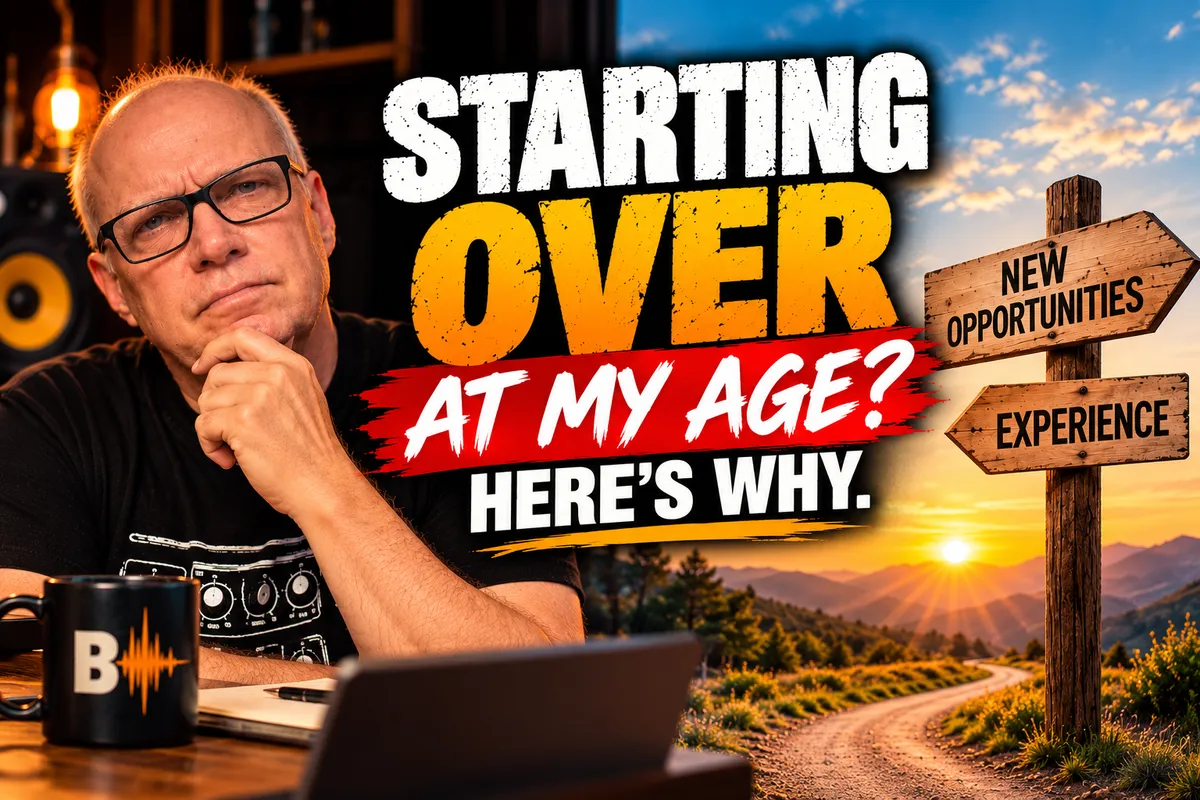
After 40 Years in Business, I'm Starting Over. Here's Why
You're not starting from zero. You're starting from experience.
I've been in the audio business for more than 40 years.
I've worked with some incredible artists, recorded and mixed a lot of music, owned a commercial recording studio for more than 20 years, and made a living doing something I genuinely love.
But recently, things changed.
I closed my commercial recording studio and began a new chapter of my career.
I'm still mixing, producing, and helping people in the audio industry. But I'm doing things differently now. I'm working remotely, keeping things simple, and looking at opportunities I probably wouldn't have considered years ago.
And somewhere along the way, I found myself asking a question I never thought I'd be asking at this stage of my life.
Am I too old to start something new?
After all these years, do I really want to build another business? Do I have the energy? Do I even know where to begin?
Then something occurred to me.
I'm not starting from zero.
I've got more than 40 years of experience to work with.
And chances are, if you've spent a good portion of your life working, learning, and solving problems, you do too.
Starting Over Doesn't Mean Starting From Scratch
When we hear the words starting over, we tend to imagine losing everything we've worked for.
All those years of effort. All the mistakes. All the lessons. Gone.
But that's not how experience works.
When I closed my studio, I didn't suddenly forget how to record a band, mix a song, work with clients, or operate a business.
Those skills didn't disappear just because I no longer had a commercial facility.
In fact, some of the most valuable things I learned had very little to do with audio equipment.
I learned how to communicate with customers, solve problems under pressure, manage projects, handle difficult situations, and keep a business operating when things didn't go according to plan.
And believe me, after more than 40 years, I've had plenty of opportunities to learn what not to do.
That's experience.
You take it with you.
Whether you've spent your career in construction, education, healthcare, accounting, sales, or the music business, you've learned things along the way that somebody else hasn't.
You might be changing direction, but you're not starting with nothing.
Your Experience Might Be Worth More Than You Think
Here's something I've noticed over the years.
The longer we do something, the more ordinary it becomes to us.
We stop thinking of it as a special skill.
It's just what we do.
For example, after decades of working in recording studios, things like signal flow, setting up a recording session, troubleshooting equipment, or dealing with clients are second nature to me.
I don't have to think very hard about most of it anymore.
But somebody opening their first recording studio?
They might spend months trying to figure out things I've been doing for years.
A simple conversation could save them an enormous amount of frustration, time, and money.
And that got me thinking.
How many other people have valuable experience they don't even recognize?
Think about the retired electrician who knows how to diagnose problems that would leave a beginner scratching their head.
Or the teacher who has spent 30 years figuring out how to explain complicated subjects in a way people understand.
Or the office manager who knows how to organize a business so things actually get done.
Those people have knowledge.
And that knowledge might be valuable to someone who needs help.
You don't have to be the world's leading expert. You just have to know how to solve a problem that somebody else is struggling with.
That's a pretty important distinction.
You Don't Have to Build Another Big Business
For most of my career, when I thought about owning a business, I thought about buildings, equipment, employees, insurance, utilities, and overhead.
That's the world I came from.
Operating a commercial recording studio meant maintaining a facility whether I had clients booked or not.
The bills didn't stop just because the calendar was empty.
And as much as I loved operating my studio, that responsibility could become exhausting.
Today, I'm looking at business a little differently.
What if you didn't need a building?
What if you didn't need employees?
What if you didn't have to invest thousands of dollars before you could even find your first customer?
Depending on what you know and the problem you can solve, you might be able to offer consulting, coaching, training, specialized services, or educational resources.
You might be able to work from home.
You might be able to start part-time while keeping your current job.
You might simply want to earn some additional income in retirement.
And that's perfectly fine.
Not everybody wants to build a company with 50 employees.
Some people just want to make a little extra money doing something they're good at.
Others want more flexibility or a way to stay productive and connected.
There's nothing wrong with any of those goals.
The important thing is figuring out what works for you.
The Hardest Part Might Be Recognizing What You Already Know
Ask somebody who's been doing the same job for 25 years what they're good at.
You might be surprised by the answer.
They'll often say something like:
"I don't know. I've just been doing my job."
But that's exactly the point.
You've been doing it for so long that you don't recognize how much you've learned.
Here's a little exercise.
Think about the questions people regularly ask you.
What do your friends come to you for help with?
What do your coworkers ask you to explain?
What problems can you solve that other people find difficult?
What mistakes have you learned to avoid?
And what do you wish somebody had taught you when you were first getting started?
Those questions can reveal a lot.
You might discover that you've developed a particular skill that other people would love to learn.
Or maybe you've created a system for doing something that saves time or money.
It doesn't have to be complicated.
In fact, sometimes the simplest solutions are the most useful.
The trick is recognizing that what seems obvious to you might not be obvious to somebody else.
But Knowing Something Doesn't Automatically Make It a Business
Now, before everybody runs out and starts creating online courses, there's something important we need to talk about.
Just because you know how to do something doesn't mean people will automatically pay you to teach it.
I've learned this lesson in the audio business.
You can have a beautiful recording studio, expensive equipment, and years of experience.
But none of that guarantees you'll have customers.
You still have to find people who need what you're offering.
The same thing applies when you're trying to earn money from your knowledge.
Start with a problem.
Who has that problem?
How are they currently dealing with it?
What would solving it be worth to them?
And are they willing to pay somebody to help?
These are the questions I'd ask before spending months building a website, recording a course, or designing a fancy logo.
Talk to people first.
Find out what they're struggling with.
Offer a simple service or solution.
See whether anybody is interested enough to pay for it.
Then learn from the experience.
Maybe it works.
Maybe you need to change your approach.
Maybe you discover that the thing you thought people wanted isn't what they actually need.
That's okay.
It's a lot better to find that out early than after spending a bunch of money building something nobody wants.
Experience creates the opportunity. Solving a real problem is what makes it valuable.
Why I Created The Know-How Method
As I started making changes in my own career, I began thinking about other people who might be facing similar decisions.
Maybe you're approaching retirement and wondering what's next.
Maybe you've spent decades working for somebody else and would like to try doing something for yourself.
Maybe you're looking for a way to earn some additional income without taking on another full-time job.
Or maybe you simply have a skill you've never considered turning into a business.
I started wondering how many people were sitting on years of valuable knowledge without realizing there might be an opportunity there.
That's what inspired me to create something new.
It's called The Know-How Method.
The idea is simple.
Help people figure out what they already know, identify who might benefit from that knowledge, and explore practical ways to get paid for sharing it.
It's a course and community built around turning real-world experience into a potential income opportunity.
We work through identifying your skills, finding people who need them, creating a straightforward offer, and testing whether there's a market for what you want to do.
And I want to be clear about something.
This isn't a get-rich-quick program.
I'm not promising that everybody can build a six-figure business or replace their salary in 30 days.
That's not how I operate.
What I do believe is that a lot of people have more to offer than they realize.
Sometimes they just need a little help figuring out what to do with it.
Real Experience. Real Opportunity.
If this sounds like something you've been thinking about, you can learn more about The Know-How Method here:
I'm Not Finished Yet
I don't know how many more years I'll be working.
But I know I'm not finished.
I'm still mixing music.
I'm still producing projects.
I'm still helping audio engineers, producers, and studio owners build better businesses.
And now I'm exploring ways to help people outside the audio industry use their experience to create new opportunities.
Do I have everything figured out?
Absolutely not.
I'm still learning.
I'm trying new things, making adjustments, and occasionally discovering that something I thought was a great idea wasn't quite as brilliant as I imagined.
But that's business.
And after 40 years, I can tell you that learning never really stops.
One of the biggest lessons I've taken away from closing my commercial studio is that changing direction doesn't mean everything you did before was a waste.
Quite the opposite.
All those years prepared me for what comes next.
And I suspect the same might be true for you.
So, What Do You Already Know?
Here's what I'd like you to think about.
What have you spent the last 10, 20, or 30 years learning how to do?
What do people regularly ask you for help with?
What problems can you solve because you've already made the mistakes and learned the lessons?
And is there somebody out there who might benefit from that experience?
You don't have to quit your job tomorrow.
You don't have to invest your retirement savings.
And you certainly don't have to build a big company.
Maybe the first step is simply recognizing that your knowledge has value and finding out whether somebody needs it.
That's where new opportunities begin.
After more than 40 years in business, I'm starting something new.
Not because everything I did before was wasted.
But because everything I did before helped prepare me for what's next.
You're not starting from zero. You're starting from experience.
— Donny Baker
Grammy®-winning Studio Owner / Engineer / Producer
The Business of Audio — Learn to make your living making music happen.
Thinking about turning your experience into income?
Take a look at The Know-How Method, my new course and community for people who want to explore building something from what they already know.
Real Experience. Real Opportunity.


