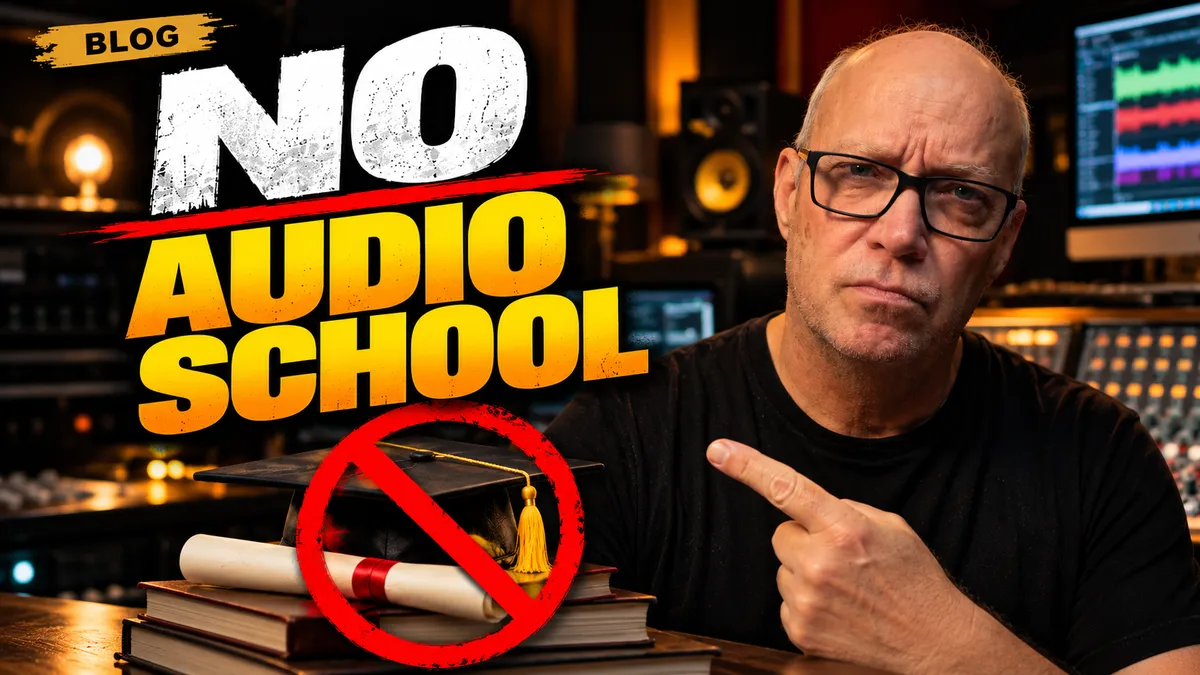
You Don't Need Audio School to Become an Audio Engineer
After more than 40 years in the audio business, here's why I believe the best way to become an audio engineer is to stop waiting and start doing.
You know what drives me crazy?
When somebody tells me they want to become an audio engineer, BUT they can't get started until they finish school, get certified in Pro Tools, or buy another microphone.
I've been doing this for more than 40 years, and I'm going to tell you something that might upset a few people.
You don't need any of those things to get started.
And if you're thinking about borrowing thousands of dollars to attend audio school, I'd encourage you to think carefully before making that decision.
I'm not saying education is bad. I'm saying you don't need to spend a fortune to begin learning how to record and mix music.
There's a difference.
The Problem: Everybody's Waiting for Something
I've talked to countless aspiring engineers over the years, and I keep hearing the same things.
"I want to get into audio engineering, but I need to go to school first."
"I can't start recording people until I have better equipment."
"I need to get certified in Pro Tools."
"I need to learn more about mixing before I take on a project."
And here's what happens.
They go to school. They buy the equipment. They watch another hundred YouTube tutorials.
But they're still not recording anybody.
They're still not mixing anything.
They're still waiting.
Preparation has replaced participation.
Don't misunderstand me. There's nothing wrong with preparing yourself. Learning is important, and you should never stop improving your skills.
But at some point, you've got to put that knowledge to work.
You can't learn to swim by watching somebody else swim.
And you can't become an audio engineer without engineering some audio.
1. Stop Waiting for Permission
Let's talk about audio school.
I know this is going to be controversial, but I've never been a big fan of somebody borrowing tens of thousands of dollars to attend an audio engineering school, especially when they're just starting out.
Why?
Because there's no guarantee that expensive education is going to translate into a well-paying job.
The audio business can be tough. Entry-level opportunities often don't pay particularly well, and it can take years to develop the skills, relationships, and reputation needed to earn a good living.
Starting that journey with a mountain of debt can make things even harder.
Now, before somebody gets upset, let me be clear.
There are some excellent audio schools out there.
They can provide structured education, access to professional equipment, experienced instructors, and opportunities to meet people in the industry.
For some students, that's absolutely worth the investment.
And certain technical or specialized positions may require formal qualifications.
But if your goal is to record bands, mix music, produce artists, or eventually operate your own studio, you don't necessarily need a degree to get started.
Think about it from the client's perspective.
An artist comes to you because they want their music to sound good.
They want somebody who understands what they're trying to accomplish.
Somebody who knows how to operate the equipment, solve problems, communicate, and deliver a finished product.
They're generally not asking to see your diploma.
They're asking whether you can do the job.
And the only way you're going to develop that ability is through experience.
Learn signal flow. Learn gain staging. Understand microphone placement, EQ, compression, and how to listen critically.
Those fundamentals matter.
Where you learn them matters a whole lot less than whether you can actually use them.
2. Use What You Already Have
Here's another one I hear all the time.
"I'd love to start recording, but I don't have the right equipment."
Really?
What do you have?
A computer? An audio interface? A microphone? Some headphones? A DAW?
Then you've probably got enough to begin.
And if you don't have recording equipment yet, you can still start developing editing and mixing skills using free software and downloadable multitrack recordings.
You don't need a $5,000 microphone.
You don't need a room full of expensive outboard gear.
And you certainly don't need another 47 plugins.
Believe me, I've worked with some pretty incredible equipment over the years. I love good gear as much as anybody.
But I've also learned something.
Good equipment doesn't automatically make somebody a good engineer.
You can put a beginner in front of a million-dollar recording console, and they're still a beginner.
On the other hand, an experienced engineer can often get surprisingly good results with relatively modest equipment.
Why?
Because they understand the fundamentals.
They know how to listen.
They know how to position a microphone.
They understand gain structure, frequency balance, dynamics, and the importance of the performance itself.
And they've learned how to work around limitations.
Sometimes having less equipment actually forces you to become a better engineer.
Instead of reaching for another plugin, you figure out why something doesn't sound right.
Instead of buying a more expensive microphone, you experiment with placement.
Instead of blaming your equipment, you start developing your ears.
That's where the real learning happens.
So before you buy another piece of equipment, ask yourself a question.
Do I actually need this to accomplish something, or am I buying it because I don't feel ready?
There's a big difference.
3. Start Doing Real Work
This is probably the most important part of the whole conversation.
You've got to start doing the work.
Not just watching somebody else do it.
Not just reading about it.
Actually doing it.
Find a friend who plays guitar and record them.
Know somebody who sings? Offer to record a vocal.
Download some multitrack files and practice mixing.
Find somebody starting a podcast and offer to help edit an episode.
Make mistakes.
Figure out what went wrong.
Try again.
That's how you learn.
And here's something else I tell the people I mentor.
Your first opportunity might be somebody you already know.
You don't necessarily need a fancy website, an advertising campaign, or thousands of social media followers.
You might already know somebody who needs help with a recording.
Maybe it's a friend in a band.
Maybe somebody at church.
Maybe a local musician you've known for years.
Start having conversations.
Tell people what you're learning and what you're working on.
Offer to help with projects that match your current abilities.
And be honest about your experience.
I'm not suggesting that you should start charging professional rates tomorrow if you don't know what you're doing.
I'm suggesting that you start building the experience that will eventually allow you to charge for your work.
There's nothing wrong with doing a few practice projects while you're learning.
Just make sure you're actually learning something from them.
Finish the projects.
Listen to the results.
Ask for feedback.
Figure out what you could have done better.
Then do another one.
Every project teaches you something that another hour of watching tutorials probably won't.
And eventually, those projects become experience.
That experience builds confidence.
And confidence, combined with actual ability, is what helps you begin taking on paying clients.
Here's My Seven-Day Challenge
I want to give you something practical to do this week.
Nothing complicated.
No expensive equipment.
No new software.
And definitely no signing up for another course just because you think you need one.
Here's the challenge.
Pick one audio project and finish it within the next seven days.
It doesn't have to be a masterpiece.
Record a song.
Mix an existing recording.
Edit a podcast.
Record a voice-over.
Anything that gets you working with audio.
But there are three rules.
Rule #1: Use what you already have.
Don't buy anything.
Work with the tools and resources available to you right now.
Rule #2: Finish the project.
Don't spend six months tweaking it.
Get it to a point where you can listen to the finished result and evaluate your work.
Rule #3: Identify one thing you could improve.
Maybe your microphone placement wasn't great.
Maybe your vocal EQ needs work.
Maybe you struggled with compression.
Good!
Now you know what to practice next.
That's how progress happens.
One project at a time.
One problem at a time.
One improvement at a time.
Stop Preparing to Become an Audio Engineer
After more than 40 years in this business, I can tell you that I'm still learning.
Technology changes.
Techniques evolve.
New tools come along.
But the fundamentals of good audio engineering haven't changed nearly as much as the equipment we use to accomplish them.
And neither has the importance of experience.
You can spend years preparing for a career in audio and never actually begin.
Or you can start today with what you've got and begin developing the skills that will eventually make you valuable to somebody else.
Will you make mistakes?
Absolutely.
I still make them.
But that's part of the process.
So the next time you catch yourself saying, "I can't get started until I..."
Ask yourself whether that thing is truly necessary.
Or whether it's just another reason to put off getting started.
Because here's what I want you to remember:
You don't become an audio engineer by waiting to become one.
You become an audio engineer by engineering audio.
Stop preparing to become an audio engineer.
Start being one.
Let's Talk About It
I'm curious about your experience.
Did you attend audio school? Was it worth the investment?
Are you self-taught?
Or are you just getting started and still wondering what your next step should be?
Leave a comment. I'd love to hear your thoughts.
And if you're interested in learning more about recording, mixing, and building a business around your audio skills, come join us at The Business of Audio.
We help aspiring audio engineers, producers, and studio owners develop their skills, find clients, and learn how to make a living doing what they love.
Join The Business of Audio:
https://www.skool.com/sound-foundations-8658/about
I'm Donny Baker.
Learn to make your living making music happen.


