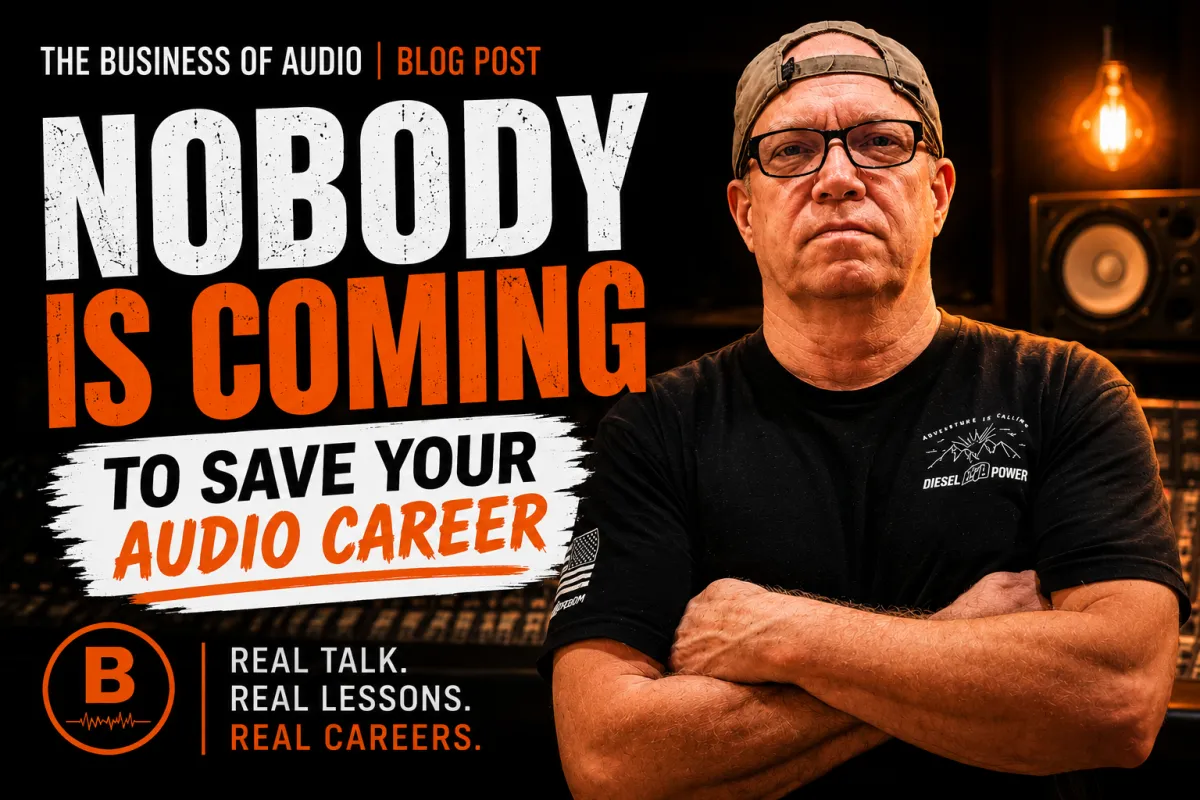
Nobody Is Coming to Save Your Audio Career
Nobody Is Coming to Save Your Audio Career
There’s a lesson I wish someone had explained to me when I first started working in audio.
Nobody is coming to save your career.
That may sound harsh.
It isn't meant to be.
In fact, once you understand it, I think it's one of the most freeing things you can learn.
When I was younger, I believed something a lot of audio engineers believe.
If I got good enough, eventually somebody would notice.
If I learned enough about recording, mixing, microphones, consoles, and gear, the work would come.
If I worked hard and made great records, somehow everything else would take care of itself.
After more than 40 years in this business, I can tell you:
It doesn't work that way.
Being Good Isn't Enough
You absolutely need to be good at what you do.
But being a good audio engineer and building a successful audio career are two different things.
I've met some incredibly talented engineers who struggled to make a living.
I've also watched engineers with less technical ability build thriving careers.
What's the difference?
They learned that their career was their responsibility.
They didn't sit around waiting for the phone to ring.
They made the phone ring.
Stop Waiting to Be Discovered
This is one of the biggest traps in the creative industries.
We love the idea of being discovered.
Someone hears your mix.
Someone sees your studio.
Someone watches your video.
And suddenly everything changes.
Sure, that happens occasionally.
But I wouldn't build a business plan around it.
Most careers are built much more slowly.
One client.
One session.
One introduction.
One referral.
One relationship at a time.
That's not nearly as exciting as getting your "big break."
But it's how real careers are built.
Start Building Instead
At some point, you have to stop waiting and start building.
Reach out to someone you know.
Tell people what you do.
Follow up with an old client.
Ask for the referral.
Create a simple way for people to hire you.
Build a system for handling inquiries.
Answer your emails.
Deliver when you say you will.
Stay in touch after the session is over.
None of this requires another plugin.
And none of it requires a $10,000 microphone.
It requires action.
Your First Client May Be Closer Than You Think
One of the things I teach new engineers is to stop assuming their first client is some stranger on the internet.
Look around you first.
Who do you already know?
Musicians.
Bands.
Churches.
Podcasters.
Content creators.
Local businesses.
Friends of friends.
People you've worked with before.
Your existing network is often the easiest place to find your first paying client because those people already know you.
You're not starting from zero.
You're starting with relationships.
Build a Reputation, Not Just a Portfolio
Your portfolio tells people what you can do.
Your reputation tells people what it's like to work with you.
And reputation is powerful.
Do you show up?
Do you communicate?
Do you solve problems?
Do you make clients feel comfortable?
Do you deliver when you promised?
Would someone recommend you to a friend?
Those questions may have more to do with the longevity of your career than which compressor you use on the vocal.
Nobody Is Coming — And That's the Good News
Here's the other side of this.
If nobody is coming to save your audio career...
Nobody gets to decide whether you can have one either.
You don't need permission.
You don't need a record deal.
You don't need a huge studio.
You don't need thousands of followers.
And you don't need to wait until somebody decides you're ready.
You can start building right now.
Start with the skills you have.
Start with the gear you have.
Start with the people you know.
Then get a little better every time you do it.
Play the Long Game
Careers aren't built in 30 days.
Businesses aren't built from one Instagram post.
And success rarely comes from one lucky break.
You build something sustainable by doing the small things consistently.
Do good work.
Treat people well.
Stay in touch.
Keep learning.
Build systems.
Ask for the business.
Then do it again.
And again.
And again.
That's not particularly glamorous.
But it works.
Final Thoughts
After more than four decades in this industry, I've learned that waiting is one of the most dangerous things you can do with your career.
Don't wait until you're better.
Don't wait until you have more gear.
Don't wait for somebody to discover you.
Don't wait for the phone to ring.
Take responsibility for where you want to go and start building toward it.
Nobody is coming to save your audio career.
And that's okay.
Because you don't need anyone to.
Ready to Build a Real Career in Audio?
Join hundreds of audio engineers, producers, and studio owners learning how to build real businesses.
